Global Ethical Management Standards
Setting the standards for ethical, intelligent management worldwide
World needs GEMS
The world urgently needs the Global Ethical Management Standards (GEMS) because the current systems of governance and corporate management are failing to keep pace with the moral, technological, and relational complexities of the modern economy.
Widespread loss of trust in institutions, corruption, and unethical leadership continue to erode social stability and economic growth. While innovation and artificial intelligence advance rapidly, the ethical frameworks guiding managerial decisions remain outdated or absent.
GEMS provides a unified, measurable standard that integrates ethics, intelligence, and accountability, ensuring that decisions made by people and systems alike serve transparency, fairness, and long-term sustainability. It is the next evolution of global management integrity.




FAQs
What is GEMS?
GEMS are global ethical management standards aligned with ISO and Applied Management Intelligence (AMI) framework.
Who uses GEMS?
Managers and Organizations worldwide who care about their clients and employees, ethics, sustainability and improving political, economic and social outcomes can adopt GEMS to ensure ethical and intelligent management practices.
What benefits does GEMS offer?
It promotes transparency, accountability, and ethical decision-making globally. Applying GEMS helps win clients' trust and employees' loyalty.
How can organizations implement GEMS?
Organizations can integrate GEMS by aligning policies with its principles and training teams accordingly.
Purpose and Nature of the GEMS Ecosystem
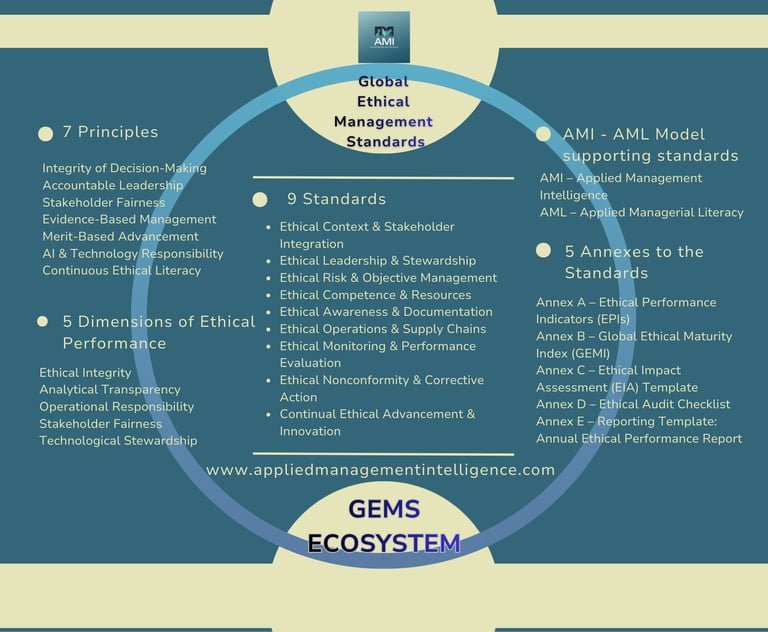
The Global Ethical Management Standards (GEMS) ecosystem provides an integrated framework that unites ethical governance, managerial intelligence, and measurable accountability across all levels of an organization.
It does not treat ethics as a peripheral code or corporate value statement - it positions ethics as a system of management, supported by defined structures, competencies, measurable outcomes, and continual improvement. The GEMS ecosystem functions as a living management architecture, where all components — principles, standards, performance dimensions, literacy frameworks, and annex tools — interlock to ensure that every decision, policy, and technological process is guided by integrity, fairness, and accountability.
Core Logic of the Ecosystem
At the center of the system is the GEMS Core, representing the nine Ethical Management Standards.
They form the auditable and actionable heart of the framework — the operational mechanisms that organizations must implement to ensure ethical behavior is systematic, measurable, and sustainable.
Surrounding this operational core are four supporting domains:
Ethical Principles - foundational moral commitments;
Dimensions of Ethical Performance - how performance is assessed and evidenced;
AMI–AML Model - how intelligence and human competence sustain ethical management;
Annexes to the Standards - how organizations implement, audit, and report ethical performance.
Together, these domains form a closed ethical ecosystem, where principle, system, competence, and evidence continuously reinforce one another.
The Nine Ethical Management Standards
These are the core of the ecosystem, defining the operational and auditable structure of the Ethical Management System (EMS).
Ethical Context & Stakeholder Integration
Organizations must understand their ethical environment, map stakeholder rights and expectations, and define system boundaries.Ethical Leadership & Stewardship
Leadership acts as stewardship — ensuring ethics is built into governance, strategy, and culture.Ethical Risk & Objective Management
Ethical risks are identified, measured, and mitigated through planned objectives and proactive controls.Ethical Competence & Resources
Organizations must ensure people have the capability and tools to apply ethics intelligently, with access to ethical oversight and education.Ethical Awareness & Documentation
Ethical information, reporting, and communication must be transparent, accessible, and verifiable.Ethical Operations & Supply Chains
Every process and partnership must be designed and controlled in accordance with ethical requirements.Ethical Monitoring & Performance Evaluation
Continuous assessment of ethical behavior using verified data and performance indicators.Ethical Nonconformity & Corrective Action
Ethical failures must be investigated, corrected, and used to improve systemic resilience.Continual Ethical Advancement & Innovation
Organizations must continually evolve ethical maturity and governance to meet emerging challenges.
Each standard is auditable and contributes to the continuous improvement of ethical performance at both managerial and organizational levels.
The Seven Ethical Principles
The principles define the normative foundation - the moral rationale for all other components of GEMS.
Integrity of Decision-Making
Accountable Leadership
Stakeholder Fairness
Evidence-Based Management
Merit-Based Advancement
AI & Technology Responsibility
Continuous Ethical Literacy
They establish the ethical expectations for both individuals and institutions and act as the moral “north star” for the standards.
The Five Dimensions of Ethical Performance
These are the key measurement lenses through which the ethical quality of an organization’s management system is assessed.
They correspond to the ethical performance indicators (EPIs) detailed in Annex A.
Ethical Integrity – conformance with moral commitments and transparency.
Analytical Transparency – evidence-based reasoning and data traceability.
Operational Responsibility – accountability and reliability in process execution.
Stakeholder Fairness – equitable treatment and inclusion of affected parties.
Technological Stewardship – human oversight, privacy, and ethical use of technology.
These dimensions ensure that ethical performance is not subjective but quantifiable, enabling consistent benchmarking and auditing.
AMI-AML Model: The Intelligence and Literacy Foundation
The Applied Management Intelligence (AMI) and Applied Managerial Literacy (AML) framework provides the cognitive and behavioral infrastructure for ethical management.
AMI (Applied Management Intelligence) defines how ethics, data, and managerial judgment interact in decision-making systems. It governs the flow of intelligence through an ethical lens ensuring decisions are both informed and moral.
AML (Applied Managerial Literacy) defines what managers must be able to do to act ethically. It comprises five core literacies:
Ethical Literacy
Analytical Literacy
Operational Literacy
Stakeholder Literacy
Technological Literacy
Together, AMI and AML sustain the human and systemic intelligence that enables the GEMS Standards to function effectively.
Annexes to the Standards - Implementation Instruments
The five annexes provide the tools and methodologies that translate the standards into operational practice and evidence:
A Ethical Performance Indicators (EPIs) defines quantitative and qualitative metrics for ethical performance evaluation
B Global Ethical Maturity Index (GEMI) measures organizational ethical maturity across four levels.
C Ethical Impact Assessment (EIA) Template evaluates ethical implications of decisions, innovations, or AI deployments.
D Ethical Audit Checklist provides a standardized method for internal and external ethical audits.
E Annual Ethical Performance Report Template guides transparent reporting of ethical performance outcomes.
The annexes operationalize GEMS, ensuring that ethical governance is not only conceptual but practical, traceable, and reportable.
The Systemic Interaction: How the Ecosystem Functions
The GEMS ecosystem operates as a closed-loop ethical management system:
Principles define the moral intent.
Standards convert intent into structured managerial requirements.
AMI–AML provides the human and systemic intelligence needed to apply the standards.
Dimensions of Ethical Performance measure the effectiveness and integrity of implementation.
Annexes provide the tools and evidence base for verification and continual improvement.
This creates a self-reinforcing system:
Ethical decisions generate measurable performance data.
Performance data inform audits and reviews.
Reviews feed back into the next planning and leadership cycle.
Over time, the organization evolves toward higher ethical maturity (as measured by GEMI).
The GEMS Ecosystem as an Ethical Governance Model
GEMS transforms ethics into a measurable management function that operates across cultures, industries, and technologies.
Its architecture ensures that:
Ethical behavior is not dependent on personal virtue alone but supported by system design.
Ethical intelligence (AMI–AML) is institutionalized.
Accountability is transparent and evidence-based.
Ethics adapts to technological and societal evolution.
Thus, the GEMS Ecosystem represents the next generation of ethical governance - one that connects moral philosophy, managerial science, and data integrity into a unified, practical framework for ethical excellence.
The GEMS Ecosystem ensures that organizational power, technology, and intelligence are exercised with integrity, fairness, and accountability transforming ethics from aspiration into architecture.
© 2026 Applied Management Intelligence (AMI). All rights reserved.
Content, graphics, and materials are protected under international copyright law.
Reproduction, distribution, or use of this material without written permission from AMI is strictly prohibited.