Building Ethical, Transparent, and Intelligent Organizations for the 21st Century
In an era shaped by digital transformation, complex global markets, and rapidly evolving technologies, organizations need more than operational efficiency — they need managerial intelligence.
The Applied Managerial Intelligence (AMI) Framework provides a practical model for organizations to align ethical leadership, data-driven competence, and stakeholder accountability into a single coherent system.
AMI is the core intelligence engine of the Global Ethical Management Standards (GEMS) - translating ethical values into measurable management performance.
Applied Managerial Intelligence (AMI) is a management model designed to help organizations make ethical, informed, and transparent decisions. It is based on five pillars integrating ethics, governance, data, and innovation into one framework, ensuring that management practices are not only effective but also trustworthy and sustainable.
At its core, AMI connects human judgment and artificial intelligence, transforming how organizations manage competence, relationships, and responsibility.
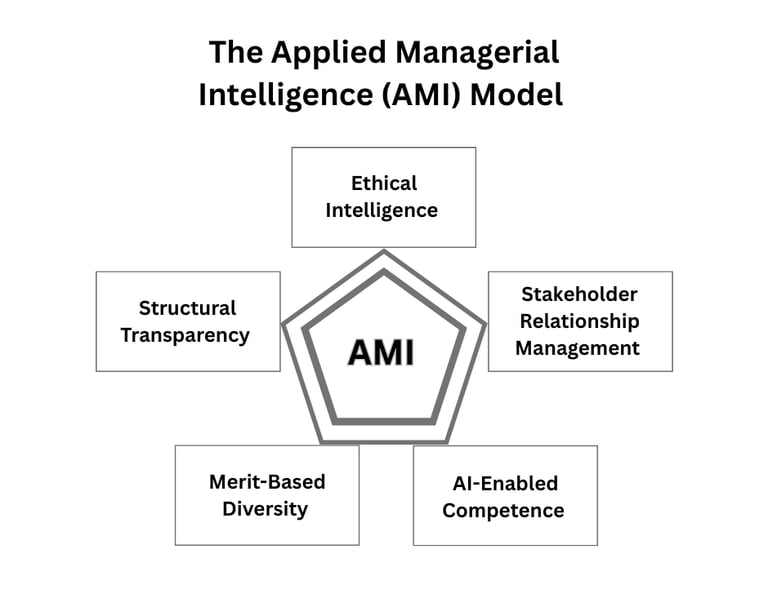
AMI Framework
The AMI Model is built on five interconnected pillars that define intelligent and ethical management:
1. Ethical Intelligence
Ethical Intelligence is the foundation of AMI.
It represents the ability of an organization to reason, decide, and act ethically - not as a compliance exercise, but as a management capability.
Through Ethical Intelligence, leadership integrates fairness, accountability, and moral clarity into every decision-making process.
Outcome:
Organizations make decisions that align profit with principle - strengthening trust, reputation, and legitimacy.
2. Structural Transparency
Transparency is the infrastructure of modern governance.
AMI ensures that systems, data, and decision flows are visible, auditable, and accountable at every level.
Structural Transparency promotes clarity between intention and action - reducing corruption risk, bias, and miscommunication.
Outcome:
Clear, evidence-based management that supports responsible reporting and open communication across stakeholders.
3. Stakeholder Relationship Management
In today’s interdependent world, leadership must manage not only shareholders but all stakeholders - employees, clients, suppliers, communities, and regulators.
AMI emphasizes fairness, engagement, and long-term value creation through responsible stakeholder relationships.
Outcome:
A trust-based organizational ecosystem built on dialogue, respect, and shared accountability.
4. Merit-Based Diversity
AMI recognizes that true diversity is powered by merit and inclusion.
It moves beyond numerical diversity toward competence-driven fairness - ensuring that advancement and opportunity are earned, transparent, and equitable.
This principle strengthens both ethical credibility and organizational performance.
Outcome:
A fair, high-performing, and inclusive culture where talent and integrity drive progress.
5. AI-Enabled Competence
As artificial intelligence reshapes decision-making, AMI ensures that technology serves human ethical oversight.
It defines how organizations can use AI responsibly — integrating data transparency, algorithmic accountability, and ethical performance metrics.
AI-Enabled Competence aligns human leadership with digital systems for smarter, safer, and fairer operations.
Outcome:
An intelligent management system that uses technology ethically and effectively, ensuring decisions remain human-centered.
The Purpose of the AMI Framework
The AMI Framework provides organizations with:
A decision-making model that merges ethical reasoning and analytical precision.
A governance structure that integrates GEMS standards into strategy, performance, and technology.
A cultural framework that unites human and digital intelligence under ethical leadership.
AMI enables leaders to manage ethics as a measurable system, embedding accountability and fairness into everyday management.
AMI in Action
When implemented within the GEMS Ecosystem, AMI provides a roadmap for continuous ethical improvement.
Organizations use AMI to:
Build decision structures that are transparent and data-driven.
Ensure technology operates with ethical oversight.
Foster inclusive leadership and stakeholder trust.
Strengthen resilience and reputation through measurable integrity.
AMI transforms management into a living ethical intelligence system - adaptable, transparent, and globally consistent.
The Future of Management
The AMI Framework represents a shift from traditional management toward a new model of conscious governance - one that merges technology, ethics, and human insight. It prepares organizations to navigate complexity of AI future with integrity and lead innovation responsibly.


The relationship between AMI (Applied Managerial Intelligence) and AML (Applied Managerial Literacy) is what makes the GEMS ecosystem both intelligent and human - a balanced system of thinking and doing, structure and competence.
Modern organizations face two interconnected challenges:
How to make decisions that are ethically intelligent, and
How to ensure that people across all levels have the competence to act ethically.
The AMI–AML model - the core of the Global Ethical Management Standards (GEMS) - unites these two dimensions into a single, adaptive management system.
The AMI framework was born out of decades of international management experience and extensive research into recurring failures in corporate systems. From boardrooms to front-line operations, it became clear that many management failures were not due to lack of knowledge, but due to fragmented, unmeasurable managerial competence.
Traditional management education provided theories but not the applied literacy needed to function in today’s complex, AI-augmented, ethically exposed environments.
Applied Management Literacy establishes a globally relevant, measurable foundation for ethical and intelligent management practice:
Ethical Literacy – the ability to reason, act, and decide based on fairness, integrity, and moral accountability.
Analytical Literacy – the skill to interpret data and apply critical thinking in real-world decision-making.
Operational Literacy – mastery of transparent systems, processes, and measurable performance controls.
Stakeholder Literacy – competence in managing diverse relationships through trust, inclusion, and communication.
Technological Literacy – proficiency in using AI and digital tools responsibly and with awareness of their ethical implications.
Together, these literacies ensure that every manager working within the AMI framework is qualified, verified, and accountable not only for results - but for how those results are achieved.
Connection to the Book: Practical Management: A Comprehensive Guide to Change in the 21st Century
The book "Practical Management: A Comprehensive Guide to Change in the 21st Century" serves as the foundation and practical textbook of managerial practice.
Written for professionals, educators, and students, it translates abstract management theory into real-world strategies and measurable practices. Each chapter functions as both a standalone learning module and a blueprint for implementation, bridging the gap between theory and applied competence offering a compact, experience-driven curriculum that helps readers:
Transition from authority-based leadership to evidence-based management.
Implement ethical, merit-driven systems of decision-making.
Integrate AI tools responsibly without sacrificing human judgment.
Develop personal accountability and data-backed transparency.
Build organizations that are resilient, fair, and corruption-resistant.
Why Applied Management Literacies Matter
They create a common professional language for ethical and intelligent management worldwide.
They enable certification and benchmarking of managerial competence.
They redefine management as a custodial profession, where integrity and intelligence are inseparable from performance.
They provide a foundation for the Global Ethical Management Standards (GEMS) as international certification for managers adhering to AMI principles.
The AMI-AML model emerged as both a response and a solution:
A response to the global management crisis — and a solution that replaces outdated leadership models with structured, measurable, ethical intelligence.
The book "Practical Management: A Comprehensive Guide to Change in the 21st Century" is not just a companion to this framework, it is its first comprehensive manual, offering every professional the opportunity to not only learn management, but to elevate it into a verified profession of trust and integrity.
© 2026 Applied Management Intelligence (AMI). All rights reserved.
Content, graphics, and materials are protected under international copyright law.
Reproduction, distribution, or use of this material without written permission from AMI is strictly prohibited.